Research portfolio

Ph.D. researcher in robotics, controls, and advanced manufacturing.

Ph.D. candidate in Mechanical Engineering with 3+ years of expertise in manufacturing robotics, real-time control systems, and machine learning. Skilled in digital controls, multi-modal sensing, computer vision, and real-world machine learning. Developed learning-based algorithms spanning reinforcement learning, iterative learning control, and vision-language models (VLMs) to drive data-driven process optimization and robust disturbance rejection in robotic platforms. Published and presented in top robotics, manufacturing and controls venues; passionate about bridging practical robotics engineering and AI to build scalable, general-purpose robotic intelligence.

  • Real-time Robotics Software (C++ · Linux)
  • Advanced Manufacturing
  • Controls & estimation (digital control · ILC · system ID)
  • Perception-driven autonomy (vision · thermal · VLM)

Exploring full-time robotics / controls / automation roles, open to collaborations and technical talks.

Selected projects

Hardware-backed work with media where it clarifies the stack.

Digital glass forming with learning-based control

Production real-time stack · Multi-sensor glass cell

Deployed multithreaded C++/rt-preempt Linux software on a multi-axis volumetric glass cell—kHz-class synchronized sensing and actuation, identified dynamics, z-domain tracking, and spatial ILC for repeatable layer builds under plant uncertainty.

Fused thermal, vision, and motion feedback on deployed hardware to hold tight process envelopes and cut defect modes; layered VLM/VLA-style supervision for fault-prone operating regions. Related morphology/vision results in SFF 2025 proceedings.

Glass · real-time
  • Real-time C++
  • Linux (PREEMPT_RT)
  • Closed-loop process control
  • Iterative learning control (ILC)
  • Reinforcement learning (RL)
  • Q Learning
  • Sensor fusion
  • VLM / VLA

Vision-based digital metal forming

In-line machine vision · ILC on EtherCAT cell

Built an OpenCV in-line estimator for tool deflection and part geometry from camera + laser-line data on a dieless forming machine, then closed pass-to-pass quality loops with force/motion-informed ILC and EtherCAT drives plus mixed digital/analog I/O—tightening springback-limited profiles run over run on shop-style hardware (ASME ISFA 2024; see playlist for runs).

Metal · vision + ILC
  • OpenCV
  • Computer vision
  • Iterative learning control
  • EtherCAT
  • Closed-loop manufacturing
  • Force feedback
  • Motion control

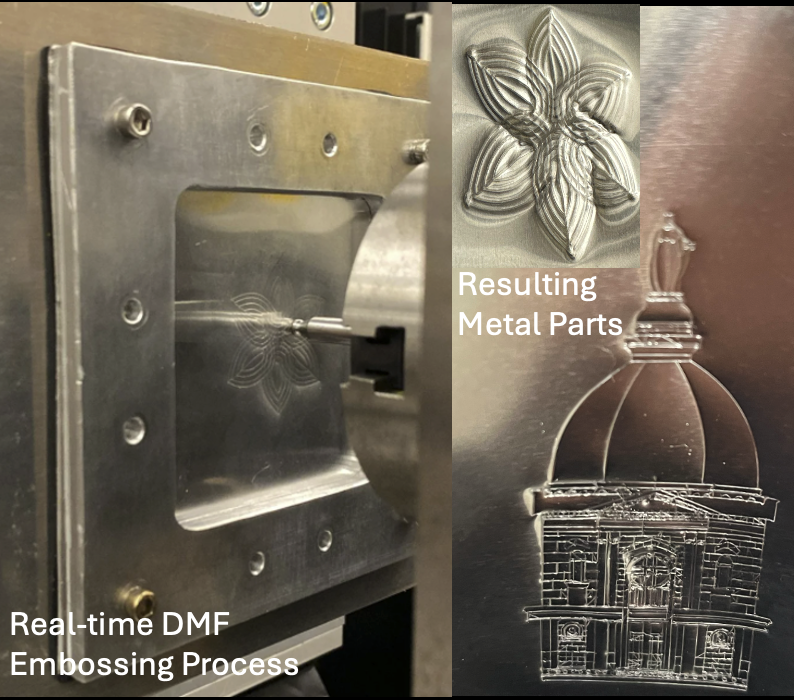
ISF metal embossing & sheet forming

Integrated motion · Sheet-metal process demos

Integrated 3-axis production-style motion for incremental sheet forming (ISF) and embossing: Yaskawa Σ-7 servos, Schunk staging, NI DAQmx encoder feedback, and RS232 force signals for safe stop/branch logic—then translated CAD surfaces to executable paths and characterized the drive chain on hardware.

Produced sheet-metal demonstration parts (leaf and campus façade motifs) for design review and process walkthroughs.

ISF · motion ISF metal embossing and incremental sheet forming: process setup and fabricated sheet-metal parts
  • Multi-axis motion control
  • Servo drives
  • NI DAQmx
  • CAD to path
  • System identification
  • Incremental sheet forming
  • Manufacturing automation

User intent recognition for EksoGT

ML front-end · Human-in-the-loop exoskeleton

Trained PyTorch stacked LSTMs on EksoGT joint-kinematic time series to classify four user-intent modes for safer shared-control gait assistance—benchmarked against classical baselines with confusion and feature-importance views to pick deployable signal sets.

HRI · exoskeleton Visualization of EksoGT exoskeleton user intent recognition experiment
  • PyTorch
  • LSTM
  • Time-series classification
  • Human-in-the-loop robotics
  • Exoskeleton control
  • Sensor fusion (kinematic)

CUDA PIC two-stream instability

GPU kernels · Numerical acceleration portfolio

Accelerated a 40k-particle electrostatic particle-in-cell (PIC) plasma simulator in C/CUDA with custom kernels for Jacobi Poisson, grid–particle gather/scatter, and synchronized iteration—achieving a large wall-clock speedup versus the same physics on a serial CPU reference.

GPU · HPC
  • CUDA
  • C / C++
  • GPU computing
  • Parallel algorithms
  • High-performance computing
  • Numerical methods

KUKA iiwa 7-DOF manipulator control

Graduate robotics course · Simulation-only validation

Modeled a 7-DOF KUKA iiwa in URDF/DH, implemented SE(3) forward kinematics and damped least-squares inverse kinematics, generated smooth joint trajectories from Cartesian waypoints, and tracked paths with computed-torque control using full rigid-body dynamics in MATLAB—validated in 3D simulation (AME 50551, Introduction to Robotics).

Course · simulation
  • Robot kinematics
  • Inverse kinematics
  • Trajectory planning
  • Computed-torque control
  • MATLAB
  • URDF
  • Robot simulation

Publications

Proceedings and patent filing aligned with digital forming, sensing, and control.

  • Systems and Methods of Printing 3D Lattices PCT International Patent Application PCT/US2026/010502 · 2026 · University of Notre Dame (assignee)
  • Temperature Control of Digital Glass Forming Processes arXiv preprint arXiv:2604.00135 [eess.SY] · 2026 · University of Notre Dame, Los Alamos National Laboratory View paper
  • Development of a Digital Metal Forming System ASME International Symposium on Flexible Automation (ISFA) · 2024 View paper
  • Real Time Vision-Based Morphology Tracking of Glass Additive Manufacturing Processes Solid Freeform Fabrication (SFF) Symposium · 2025 Conference proceedings

Experience

Research, teaching, and earlier industry analytics.

Graduate Research Assistant – Robotics · University of Notre Dame

Notre Dame, United States · 2021 – Present

Own integration for multi-axis glass and metal forming cells: deterministic C++ on rt-preempt Linux, kHz-class sensing (thermal, vision, confocal, encoders), digital control and ILC, safety-oriented monitoring, and learning-assisted recovery—leading to publications and a patent filing.

Graduate Teaching Assistant · University of Notre Dame

Notre Dame, United States · 2021 – 2024

Mechanics, dynamics, vibrations, and controls labs; mentored students on servo tuning, motion interpolation, trajectory generation, and sensor integration.

Research Analyst, Strategy & Marketing · The Smart Cube

Delhi, India · 2018 – 2019

Market and competitive intelligence for consulting and Fortune 100 clients—structured research, synthesis, and stakeholder-ready briefs (pre-Ph.D.).

Coursework

Notre Dame graduate coursework (Robotics and Dynamics pillar)—representative topics by area.

Core robotics and controls

  • AME 50551 - Introduction to Robotics: SE(3) representations, homogeneous transformations, Denavit-Hartenberg convention, forward and inverse kinematics, Jacobian-based velocity kinematics, singularity analysis, rigid-body dynamics, Newton-Euler and Lagrangian formulations, trajectory planning, linear and nonlinear manipulator control, force and impedance control.
  • AME 60621 - Optimization-Based Robotics: Spatial vector algebra, recursive dynamics, contact and impact modeling, system identification, dynamic programming, HJB equation, LQR, Pontryagin's Maximum Principle, single and multiple shooting, direct collocation, differential dynamic programming, model predictive control, ZMP planning, floating-base and centroidal dynamics, operational-space control.
  • AME 60652 - Intermediate Controls: Feedback and feedforward architectures, electromechanical system modeling, brushed and brushless motor dynamics, least-squares estimation, Lyapunov stability, state and output feedback control, PID control and tuning, observer-based estimation, controller implementation for practical mechatronic systems.
  • AME 60650 - Digital Control Systems: Discrete-time state-space models, controllability and observability, observer design, pole placement, internal model principle, Z-transform methods, A/D and D/A sampling hardware effects, transfer-function to state-space conversion, deadbeat control, tracking control, delay systems, Jury and Routh-Hurwitz stability analysis, frequency-domain design and margins.
  • AME 60673 - Kinematics of Human Motion: Biomechanics, motor control, optimal feedback control, gait analysis, balance, central pattern generators, locomotion models.

Perception, estimation, and computation

  • EE 80690 - Robot Perception and Reasoning Image segmentation, edge detection, epipolar geometry, camera calibration, visual odometry, structure from motion, visual SLAM, loop closure, bundle adjustment, feature descriptors (SIFT, SURF, ORB, BRISK), place recognition, stereo vision, LiDAR and range sensing, sensor noise modeling.
  • CSE 60535 - Computer Vision: Image formation and processing, Fourier methods, segmentation and morphology, feature extraction and selection, Bayesian inference, classical and neural classifiers, optical flow, object tracking, Kalman and particle filtering, camera geometry, stereo correspondence, 3D reconstruction, reliability and trustworthiness in vision systems.
  • AME 60617 - Bayesian Data Assimilation and State Estimation: Bayesian inference, computational statistics, Monte Carlo sampling, Kalman filter variants (EKF, UKF, Gauss-Hermite, cubature), particle filtering, Bayesian smoothing, state-parameter estimation, posterior recursion, surrogate models, MCMC, MAP, and MLE methods.
  • ACMS 60212 - Advanced Scientific Computing: Advanced C/C++ programming, templates and memory management, MPI fundamentals, parallel algorithms for linear systems, sub-domain decomposition for PDEs, numerical methods for large systems, GPU computing with CUDA, and stochastic simulation with Monte Carlo methods.

Mathematical foundations

  • AME 60623 - Analytical Dynamics: Vector kinematics and dynamics, moving reference frames, work-energy methods, generalized coordinates and constraints, calculus of variations, Hamilton's principle, Lagrange and Hamilton equations, rigid-body dynamics, impulse-momentum methods, and constrained multibody system modeling.
  • AME 60611 - Mathematical Methods I: Multivariable calculus, ODE solution methods, perturbation and series methods, Sturm-Liouville theory, vector and tensor calculus, linear operators, matrix decompositions, least squares, nonlinear dynamics, bifurcation analysis, and constrained optimization techniques.
  • AME 60619 - Fractional Calculus for Engineers: Riemann-Liouville, Caputo, and Grunwald-Letnikov derivatives, numerical fractional differential equations, Laplace-domain analysis, fractional-order PID control design, and frequency-domain stability analysis for fractional systems.
  • ACMS 60786 - Applied Linear Models: Simple and multiple linear regression, matrix-based least squares, statistical inference, diagnostics and residual analysis, hypothesis testing, model selection and validation, multicollinearity analysis, and Bayesian linear regression.

Leadership

  • GRED 60802 - Leadership and Social Engagement (LASER Program): Ethical leadership, scientific communication, conflict resolution, team development, research impact and engagement.

Contact

Open to full-time robotics, controls, and autonomy roles (industrial or R&D). Also happy to discuss internships, collaborations, or speaking on real-time systems and manufacturing robotics.